
Grandidier's Baobab is one of only eight species of Baobabs in the world. Of these eight, six are found only in Madagascar, one in Africa and one in Australia. The Grandidier Baobab is the largest and tallest of the Madagascar Baobabs.
Showing posts with label baobab. Show all posts
Showing posts with label baobab. Show all posts

Largest Baobab in the world

"Big Baobab Tree (Adansonia digitata): This giant and ancient baobab at the Sunland Nursery, between Duiwelskloof and Ga-Kgapane, is the biggest specimen in the world. It has a circumference of 46,8m and carbon dating has determined its age at an astronomical 6000 years." from http://www.places.co.za/html/tzaneen.html
"When baobabs become a thousand years old, they begin to hollow inside. In the Big Baobab this has resulted in wonderful caverns and caves, where the world famous Baobab Tree Bar and Wine Cellar now amaze visitors. The tree bar can accommodate more than 60 people!"
from http://www.bigbaobab.co.za/
see also...
http://arbresvenerables.free.fr/ArbresVenerables/South%20Africa.htm
Chapman´s Baobab - botswana
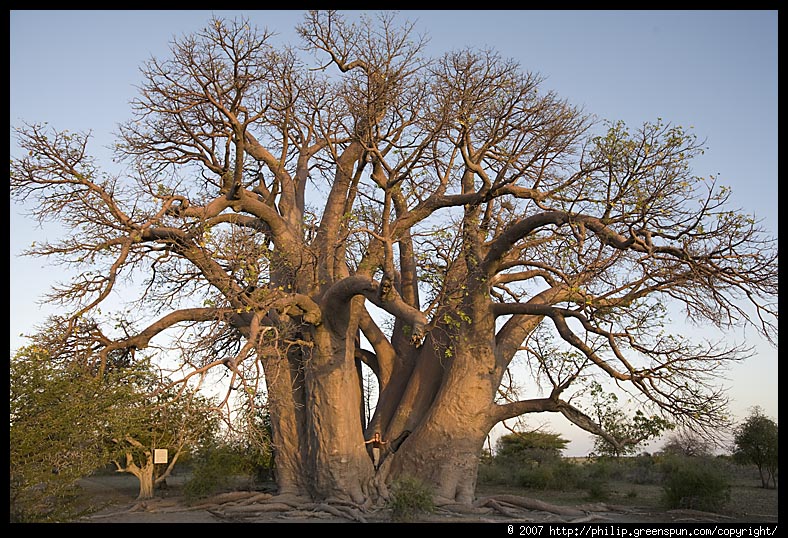
In Botswana´s Kalarari Desert near the Makgadikgadi Pans (once a very immense inland lake in
here is the same tree from another angle...

Baobab tree prison

This Baobab tree in Western Australia has an opening on one side that leads into it hollowed out interior. It seems this tree and others like it have been used as prisons. This one has enough room to hold five prisoners.
Baobab trees in a Hawaii park

This cluster of fat trunked trees is located in a Park, opposite Ala Moana Center, midway between Waikiki and downtown Honolulu in Hawaii. They are not however native Hawaiian trees! It turns out that they are Baobab trees! The Baobab tree is native to Africa and is usually seen in rather arid areas and with no leaves. It is said that these trees were a gift to one of the last monarchs of Hawaii.
I´ve heard of these trees being called the "Dead rat tree" for the look and shape of their fruit which some say looks like a dead rat hanging from the tree.Impala under a Big Baobab tree

If you have any doubt about the size of this tree look closely at the Impala that is standing in its shade. Baobab trees have very fat trunks because they use them to store large amounts of water. When the rains come the Baobab tree soaks up as much water as it can and stores the water in its trunk which swells to create a huge storage tank. Then as the dry season stretches on the Baobab's trunk slowly shrinks as the water gets used up.
Subscribe to:
Posts (Atom)


