
"The Tree of Ténéré, was a solitary acacia, of either Acacia raddiana or Acacia tortilus, that was once considered the most isolated tree on Earth — the only one within more than 400 km. It was a landmark on caravan routes through the Ténéré region of the Sahara in northeast Niger — so well known that it is the only tree to be shown on a map at a scale of 1:4,000,000...It was the last surviving tree of a group of trees that grew when the desert was less parched than it is today. The tree had stood alone for decades. During the winter of 1938–1939 a well was dug near the tree and it was found that the roots of the tree reached the water table 33–36 meters below the surface."
from wikipedia.org/
Showing posts with label Africa. Show all posts
Showing posts with label Africa. Show all posts
The Late Lone Tree of Tenere

Largest Baobab in the world

"Big Baobab Tree (Adansonia digitata): This giant and ancient baobab at the Sunland Nursery, between Duiwelskloof and Ga-Kgapane, is the biggest specimen in the world. It has a circumference of 46,8m and carbon dating has determined its age at an astronomical 6000 years." from http://www.places.co.za/html/tzaneen.html
"When baobabs become a thousand years old, they begin to hollow inside. In the Big Baobab this has resulted in wonderful caverns and caves, where the world famous Baobab Tree Bar and Wine Cellar now amaze visitors. The tree bar can accommodate more than 60 people!"
from http://www.bigbaobab.co.za/
see also...
http://arbresvenerables.free.fr/ArbresVenerables/South%20Africa.htm
Chapman´s Baobab - botswana
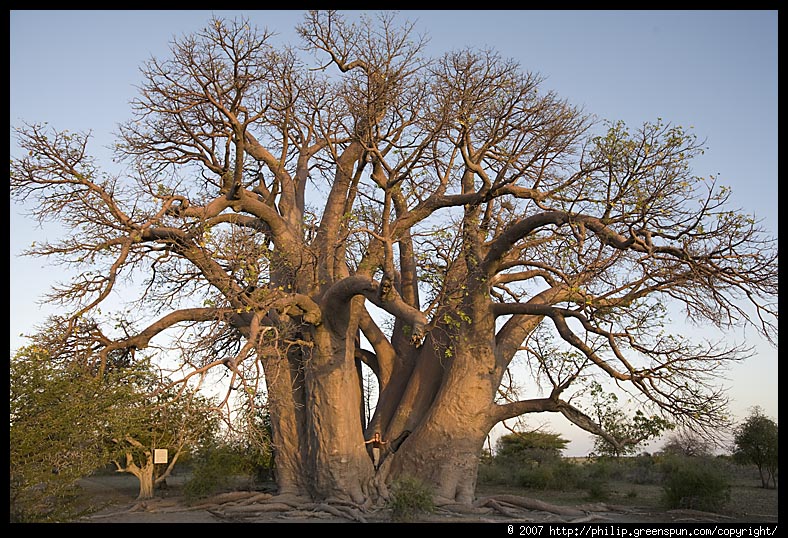
In Botswana´s Kalarari Desert near the Makgadikgadi Pans (once a very immense inland lake in
here is the same tree from another angle...

Acacia Tree on the African savanna

The mounds that can be seen in this picture or terminte hills. the big cats are using this termite hill in front of the Acacia tree as a lookout to locate new prey. Notice the vulture up on top of the Acacia. This tree looks as if it has witnessed a good many scenes of preditor and prey.
Palm tree set against an old city wall

They say the simplicity is the essence of design. There is not really anything all that complicated or complex about this image. It is just a lone palm tree (Washingtonia robusta) standing beside the wall of an old medina in Rabat, Morocco. I think that the best tree images are when the tree´s surroundings act as the frame for the tree. In this case the old medina wall provides a great backdrop that greatly enhances the picture of the tree.
An African Sausage tree

This is a rather interesting tree species from Africa. The image is a bit out of focus but you can see the fruit of this tree from which it derives its name.
Quiver Tree in South Africa

I have never seen one of these trees in person but they remind me quite a bit of the Dragon Blood tree (Draceana Draca) that is native to the Canary Islangs.
Baobab tree with leaves!

It is not very often that you see a Baobab tree picture with leaves on the tree. As far as I know Baobab trees only have leaves during a short rainy season. During this time the trees soak up water that they store in their swolen trunks. When the long dry season returns the trees drop their leaves.
Impala under a Big Baobab tree

If you have any doubt about the size of this tree look closely at the Impala that is standing in its shade. Baobab trees have very fat trunks because they use them to store large amounts of water. When the rains come the Baobab tree soaks up as much water as it can and stores the water in its trunk which swells to create a huge storage tank. Then as the dry season stretches on the Baobab's trunk slowly shrinks as the water gets used up.
Lonely Acacia tree on the grassland

There is something surreal about this image. It looks like something you might see in a dream or a vision. A lonely Acacia tree (which you normally see in dry desert or semi desert settings) set against a foggy background. I kinda makes you scan the horizon to see if there isn't some sort of Savannah animal like a Giraffe or Lion hiding in the background.
The tree itself is standing alone. A lone tree set in an almost perfect grassy plain. It must have rained recently. This tree would be a handy tree be close to should you have an unexpected encounter with a predator. I can just imagine grabbing hold of the lowest branch and swinging myself up to the upper branches to escape the charge of a Rhino or Warthog.
It also looks like a good tree for having a face to face encounter with a Giraffe. By the look of it I´d say that it´s shape has been strongly influenced by some long necked leaf eaters.
Subscribe to:
Posts (Atom)


